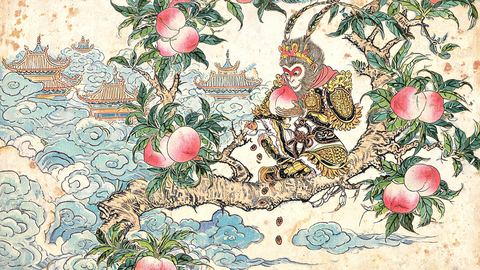
Sun Wukong is a new novel built on the opening of Journey to the West, the sixteenth-century Chinese classic. It keeps the Monkey King’s story up to the Havoc in Heaven and the five hundred years under the mountain, and tells it from a place the classic never goes: the archive of the Court that could not file him.
The classic
A hundred chapters, and seven for the Monkey King.
Journey to the West (西遊記, Xīyóu jì) was first printed in 1592 and is traditionally attributed to Wu Cheng’en. It is one of the four great classical novels of Chinese literature: a hundred chapters following the monk Xuanzang, called Tang Sanzang, on his pilgrimage west for the Buddhist scriptures, guarded by three disciples, Sun Wukong, Zhu Bajie and Sha Wujing, and by a dragon prince who carries him as a white horse.
The first seven chapters belong to the Monkey King alone: his birth from a stone, his apprenticeship, the Havoc he raises in Heaven, and the mountain the Buddha puts him under. That is the ground this novel stands on.
The classic and the retelling
Seven chapters in their own pictures, then what the novel does with them.
Where the book comes fromThe woodblock prints of the classic and the paintings of the novel were made for this site; the narrator is a generated voice.Read the narration, picture by picture24 lines
1 / 24
0:01Journey to the West was first printed in 1592:
0:05a hundred chapters, traditionally attributed to Wu Cheng’en.
0:10Its first seven chapters belong to one character.
0:14On the Mountain of Flowers and Fruit, a stone splits open, and a stone monkey is born.
0:21He leaps through a waterfall, and the monkeys make him their king.
0:26Across the sea, the Patriarch Subodhi names him Sun Wukong,
0:31and teaches him seventy-two transformations, and a cloud somersault of a hundred and eight thousand li.
0:38He takes an iron pillar from the Dragon King of the Eastern Sea,
0:42and in the Underworld he strikes his name from the Registry of Life and Death.
0:47Heaven tries to tame him with titles: Keeper of the Heavenly Horses, then Great Sage Equal to Heaven.
0:55Set to guard the Peach Garden, he eats the peaches.
0:59Left off the banquet’s guest list, he drinks its wine, and swallows Laozi’s elixirs.
1:06Heaven’s armies cannot take him. Erlang Shen can, with Laozi’s help,
1:12and forty-nine days in Laozi’s furnace only give him eyes of fire.
1:16Only the Buddha stops him: a wager in the palm of a hand,
1:21and five hundred years under Five Elements Mountain.
1:24Then the monk Tang Sanzang sets him free, and the journey west begins:
1:28eighty-one ordeals, told from inside the party.
1:35This novel keeps those events. It changes where you stand.
1:40It is told from the Celestial Archive, eleven years after the Havoc, by a scribe ordered to write the official account.
1:49The classic shows the Monkey King in every scene.
1:52Here, no one sees him whole: two seconds through a gap in a door, a voice through the stone of a seal.
2:00Journey to the West, retold from the filing room.
2:04Sun Wukong. The Comprehensive Account.
What the novel keeps
The events are the classic’s.
The stone on Flower-Fruit Mountain that cracks open, and the two beams of golden light from his eyes that reach the Jade Emperor’s hall.Chapter 4
The Water Curtain Cave, and the monkeys who crown him their Handsome Monkey King.Chapter 5
The raft across the ocean, the Patriarch Subodhi, the name Sun Wukong, the seventy-two transformations and the cloud somersault.Chapter 6
The Dragon King’s iron pillar of thirteen thousand five hundred jin, and the Registry of Life and Death, edited with the clerk’s own brush.Chapter 7
Keeper of the Heavenly Horses, Great Sage Equal to Heaven, the peaches, the elixirs and the banquet he was not invited to.Chapters 8–9
The Buddha’s wager in the palm of his hand, and five hundred years under Five Elements Mountain.Chapters 9, 22–23
Guanyin’s plan: the monk Tang Sanzang, the release, the golden headband and the road west.Part Four
What it changes
Everything about how you see them.
Read across: the classic on the left, this novel on the right, with the gap between them.Read down: the classic first, then this novel, with the gap beside it.
How Journey to the West and this novel tell the same events
Journey to the West
Sun Wukong
Who tells it
The narrator stays with the Monkey King through every scene, close enough to hear him boast.
An archivist, Wei Mingzhen, reconstructs the Havoc eleven years later from documents and witnesses. The Monkey King is never seen whole.
Heaven
A court of gods and immortals, often comic, that the Monkey King mocks and outwits.
A bureaucracy that governs by classifying. What it cannot file, it cannot see, and its archive knows exactly seven kinds of document.
Who manages him
The Great White Planet, Taibai Jinxing, talks the Jade Emperor into summoning him, and later into granting the empty title.
Both schemes belong to Chancellor Yuan Taidao, who puts the title and the rank in different columns of the registry.
The Havoc
A run of battles. Erlang Shen, helped by Laozi, finally captures him; forty-nine days in Laozi’s furnace leave him with eyes of fire, and he breaks loose again.
No Erlang Shen and no furnace. The armies cannot touch him, a commander swears he stopped himself, and the Court’s dispatches ask for help from beyond its own authority.
The feast
Made guardian of the Peach Garden, he eats the peaches, crashes the Queen Mother’s banquet and swallows Laozi’s elixir.
The same meal, read as evidence: the keeper of the garden says he chose the ripe fruit, and a records officer timed him eating the pills in order of potency.
The seal
The Buddha’s hand becomes Five Elements Mountain, sealed with a paper talisman of the six-syllable mantra, which Xuanzang climbs up and peels away.
The character 封, sealed, thirty feet high in the Buddha’s gold, pressed into warm stone. The monk recites a sutra and it cracks down its vertical stroke.
The five hundred years
A punishment for pride: iron pellets when he is hungry, molten copper when he is thirsty.
In Guanyin’s word, a pause: the time his understanding needs to meet a larger context. The mountain stays warm the whole time.
The road west
Three disciples and a dragon horse, eighty-one ordeals, demons at every pass, told from inside the party.
Only the monk and his protector, watched from a distance by a scribe with no authority to follow. Wei cannot decide whether the golden headband is constraint, or curriculum.
The manner
Comic and satirical, full of transformations and fights, and read for centuries as an allegory of the mind.
An investigation and an essay. Its narrator borrows Liu Cixin’s cosmology: a system meets something it cannot process, and its records split.
Who is new
The scribe, and nearly everyone he questions.
Wei Mingzhen is the novel’s invention, and so are the people of his investigation: Senior Scrivener Hong Jingbao, Chancellor Yuan Taidao, Commander Pine Branch, Li Wen and the soldiers of the Northern Ward, Sergeant Fang Lieyang, Records Officer Qian Yuwei, Keeper Hou Tianyi and Lady Tianmu. In the classic the Peach Garden is looked after by its local earth god; here it has a keeper of four thousand years.
From the classic and its Buddhist sources come Sun Wukong, Tang Sanzang, Guanyin and her attendant Shancai, the Buddha, the Jade Emperor with his Thousand-Li Eye and Wind-Accompanying Ear, the Patriarch Subodhi, Ao Guang the Dragon King, the Ten Kings of the Underworld, and Laozi.
Journey to the West follows the pilgrims all the way to the scriptures. This novel follows the monk and his protector only a little way down the road, and ends where it began, in the Archive: on the thirty-eighth day of a forty-day commission, with one document case and the question of what goes into the file.
Sound
Every note is played by your browser. Nothing plays until you switch it on.